New Framework Advances Safe Water Reuse for Agricultural Irrigation
Researchers have developed an innovative risk assessment framework to support safe water reuse in agriculture – a critical challenge for Mediterranean regions facing water scarcity.
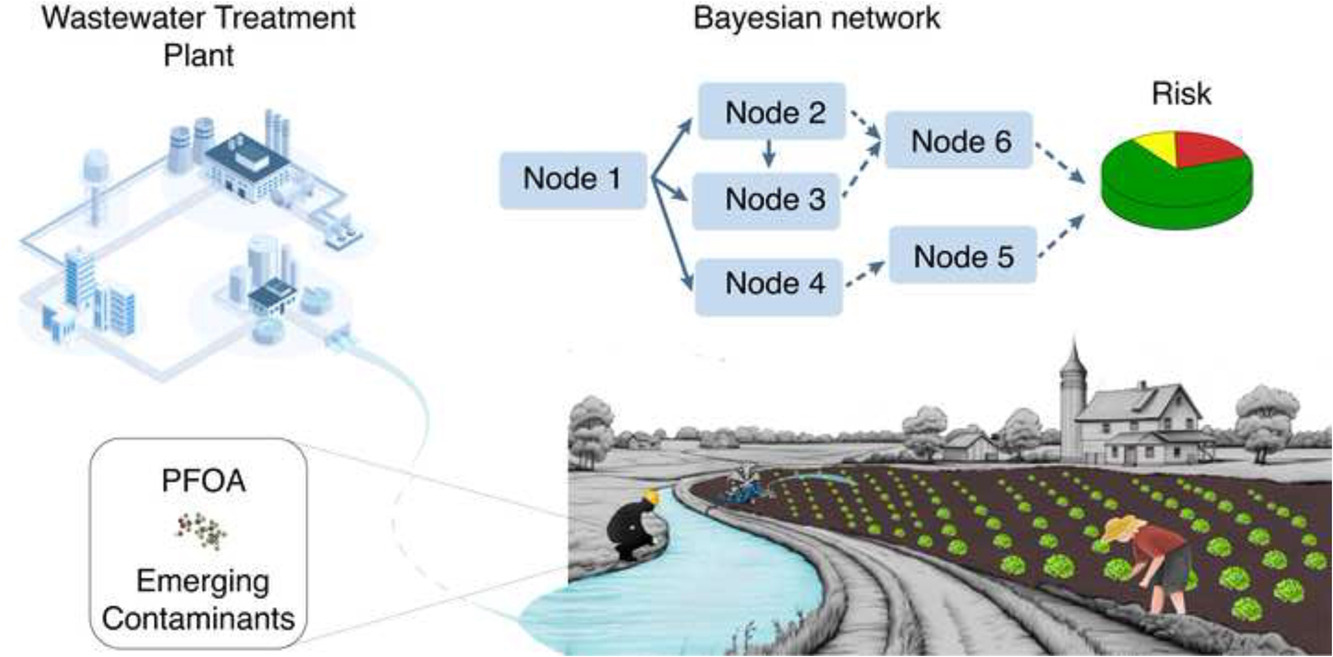
Published in Water Research, the study presents a Bayesian network approach for quantifying health risks associated with PFAS (per- and polyfluoroalkyl substances) in crops irrigated with treated wastewater. The framework addresses a key barrier to water reuse adoption: uncertainty about contaminant risks.
The research is particularly relevant for CIRQUA’s objectives:
Decision Support for Water Utilities: The model helps water managers evaluate treatment effectiveness and identify critical control points in the water reuse chain.
Adaptable to Data-Scarce Environments: The Bayesian approach can incorporate expert knowledge alongside limited monitoring data – ideal for regions where comprehensive water quality surveillance is challenging.
Multi-Barrier Perspective: The framework models risk across the entire treatment chain, supporting the kind of integrated water management CIRQUA promotes.
The study validated the model using data from two Italian wastewater treatment plants, demonstrating its practical applicability in Mediterranean contexts. Results showed acceptable risk levels when appropriate treatment barriers are in place.
As CIRQUA works to advance water reuse practices across Mediterranean partner regions, tools like this Bayesian risk assessment framework will be essential for building public confidence and regulatory support for treated wastewater applications in agriculture.
Reference: Simonetti et al. (2025). Water Research, Volume 290.